In this internship, you will be using computational chemistry (molecular dynamics simulations) and Bayesian-optimization techniques to develop a closed feedback workflow that allows for screening of
Molecular dynamics simulations play a crucial role in understanding and designing new materials, particularly in cases where experimental observations are impossible and multiple design parameters
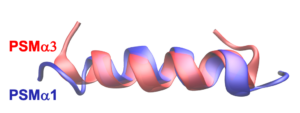
Recent breakthroughs in deep learning—highlighted by the 2024 Nobel Prize in Chemistry—have transformed our ability to study and design protein systems. Models like AlphaFold can
We refer to matter as “active” when the constituent particles convert internal energy into self-propulsion. Examples include biological systems like bacterial colonies and cell tissues,
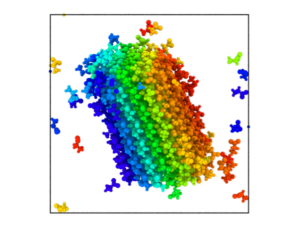
Crystallisation is a fundamental process ubiquitous in nature and of high industrial importance. This phase transition from a liquid to a solid often occurs via
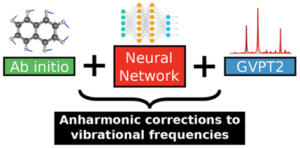
Polycyclic Aromatic Hydrocarbons (PAHs) are molecules of great astronomical interests. In this project, we aim to predict anharmonic vibrational spectra for astronomical polycyclic aromatic hydrocarbons (PAHs) using artificial neural networks.
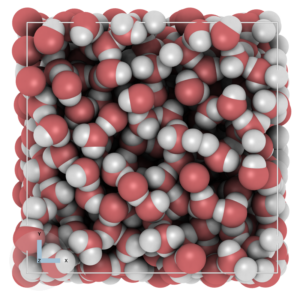
Classical water models with fixed point-charges have a fixed dipole-moment. The dipole-moment of water is known to be very different in the gas-phase compared to the liquid phase. In this project, we will attempt to create a water-model that will work in both types of density environments.
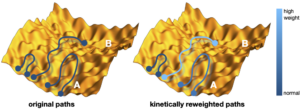
In this fundamental research project the student will elucidate how catalysis emerges by applying a novel method to optimise molecular models so that they have desired kinetic properties, such as catalysis.